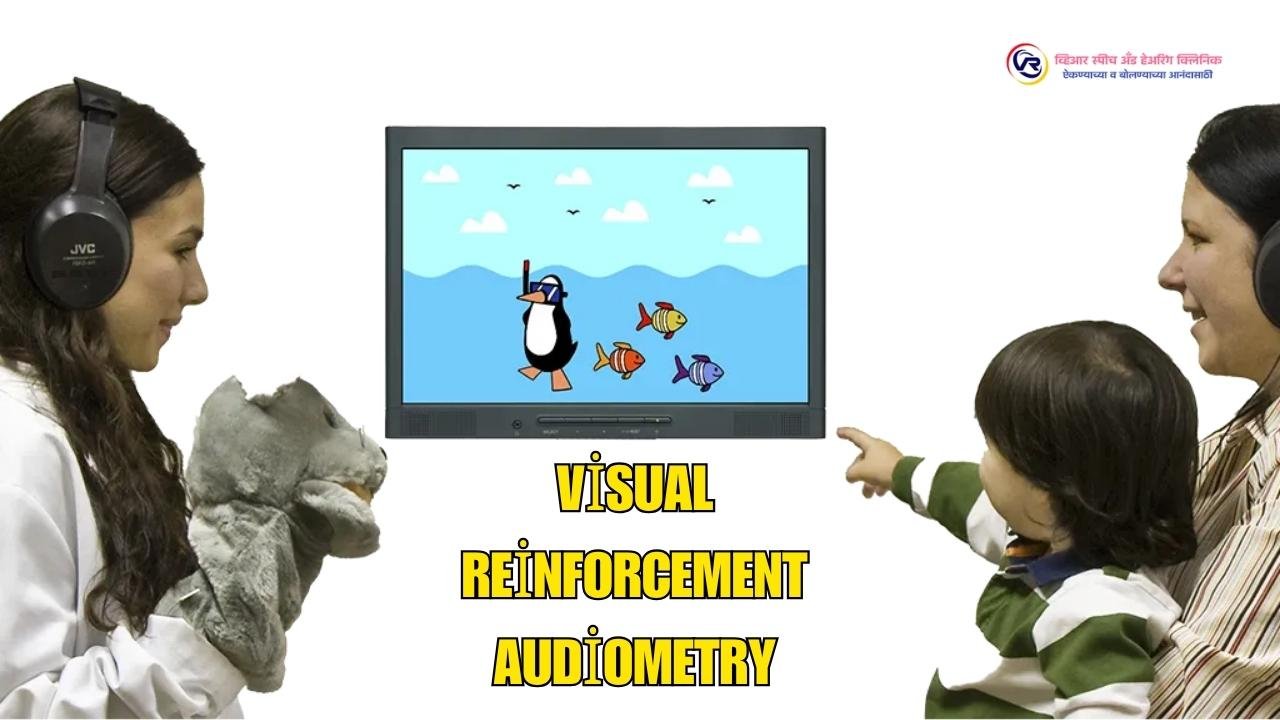
Visual Reinforcement Audiometry (VRA) is one of the most important behavioral hearing tests used in pediatric audiology. It is specially designed to assess hearing in infants and young children who are too young to follow instructions required in traditional audiometry. This article provides a clear and professional overview of VRA—its principles, procedure, and importance in identifying early hearing concerns.
What Is Visual Reinforcement Audiometry (VRA)?
Visual Reinforcement Audiometry is a behavioral hearing test used to evaluate the hearing sensitivity of children typically from 6 months to 2.5 years of age. It can also be used for older children with developmental delays or complex needs.
As the name suggests, VRA combines audiometry (hearing testing) with visual reinforcement to encourage a child to respond to sounds. When a sound is presented, the child is rewarded with an attractive visual stimulus—usually a lit-up toy or animated video—after turning their head toward the sound source.
Why VRA Works: The Two Key Principles
VRA testing is based on two core behavioral principles:
1. Conditioning
The child learns to associate a sound with a reward.
When a sound is presented, a visual reinforcer appears, teaching the child that turning toward the sound brings a reward.
2. Observing a Head Turn
A clear, time-locked head turn toward the sound source is considered the child’s response.
This head-turn response becomes the basis for measuring hearing thresholds across frequencies.
When Is VRA Used?
VRA is effective for:
-
Infants aged 6 months and above, who have developed enough neck control to turn their head.
-
Toddlers up to approximately 2.5 years.
-
Older children with developmental delays or additional needs.
How VRA Works: Step-by-Step
1. Sound Presentation
A transducer such as a loudspeaker, earphones, or bone conductor is used to deliver sound. The sound must reach the child’s ear and be audible to trigger a response.
2. Conditioning Phase
This is the most crucial stage.
-
The sound stimulus and visual reinforcer are presented simultaneously.
-
A second tester (assistant) helps by engaging the child through smiling, pointing, clapping, or moving toward the reinforcer.
-
Conditioning is considered successful when the child independently turns toward the reinforcer in response to the sound at least twice without visual cues.
If the child does not respond independently, reconditioning is repeated.
3. Testing Phase
Once conditioning is successful, threshold testing begins.
-
A 20 dB down, 10 dB up method is used to determine minimum response levels (MRLs).
-
Smaller steps may be used around threshold if needed, depending on the child’s attention span.
-
Responses are recorded using ticks and crosses on a VRA response sheet.
4. Reinforcement
Each correct head turn is rewarded immediately with a visual reinforcer to maintain attention and motivation.
Determining the Minimum Response Level (MRL)
According to the British Society of Audiology (BSA), the minimum response level is:
The lowest level at which the child responds to the stimulus in at least 2 out of 3 ascending trials (greater than 50% of the time).
Avoiding False Positives
False positives—also called “checking”—occur when a child looks toward the reinforcer even without a sound being presented.
To minimize checking:
-
Insert no-sound trials intermittently.
-
Maintain high engagement with toys and social interaction.
-
Change or rotate toys to keep the child’s focus centered forward.
Role of the Second Tester
A skilled second tester plays an essential role in:
-
Maintaining the child’s forward-facing attention.
-
Providing social reinforcement during conditioning.
-
Reducing false checks.
-
Quickly re-engaging the child when interest fades.
Why VRA Matters
VRA helps identify:
-
Hearing thresholds across key speech frequencies.
-
Early signs of conductive, sensorineural, or mixed hearing loss.
-
The need for further diagnostic hearing tests (e.g., tympanometry, OAE, ABR).
Early detection leads to early intervention—crucial for speech, language, and cognitive development.
Summary
Visual Reinforcement Audiometry is a highly effective behavioral test for infants and young children. By combining sound presentation with visual reinforcement, VRA helps audiologists assess hearing sensitivity in age groups that cannot complete traditional hearing tests.
Key points:
-
Suitable from 6 months to ~2.5 years.
-
Relies on conditioning and head-turn responses.
-
Uses visually stimulating rewards to reinforce responses.
-
Helps determine minimum response levels (MRLs) across frequencies.
-
Essential for early diagnosis and management of childhood hearing loss.