
Pure Tone Audiometry (PTA) is one of the most widely used hearing tests performed by audiologists to assess an individual’s hearing sensitivity. It measures the quietest sound a person can hear at various frequencies, helping identify the type, degree, and pattern of hearing loss.
What Is Pure Tone Audiometry?
Pure Tone Audiometry evaluates a person’s hearing thresholds using an audiometer, a device that produces pure tones at specific frequencies. These tones are delivered through:
-
Insert earphones (air conduction)
-
Bone conduction oscillator (bone conduction)
During the test, the patient signals whenever they hear the sound. The softest level at which the tone is detected is recorded as the hearing threshold.
These thresholds are plotted on an audiogram, a graphical chart used to identify hearing loss across different frequencies.
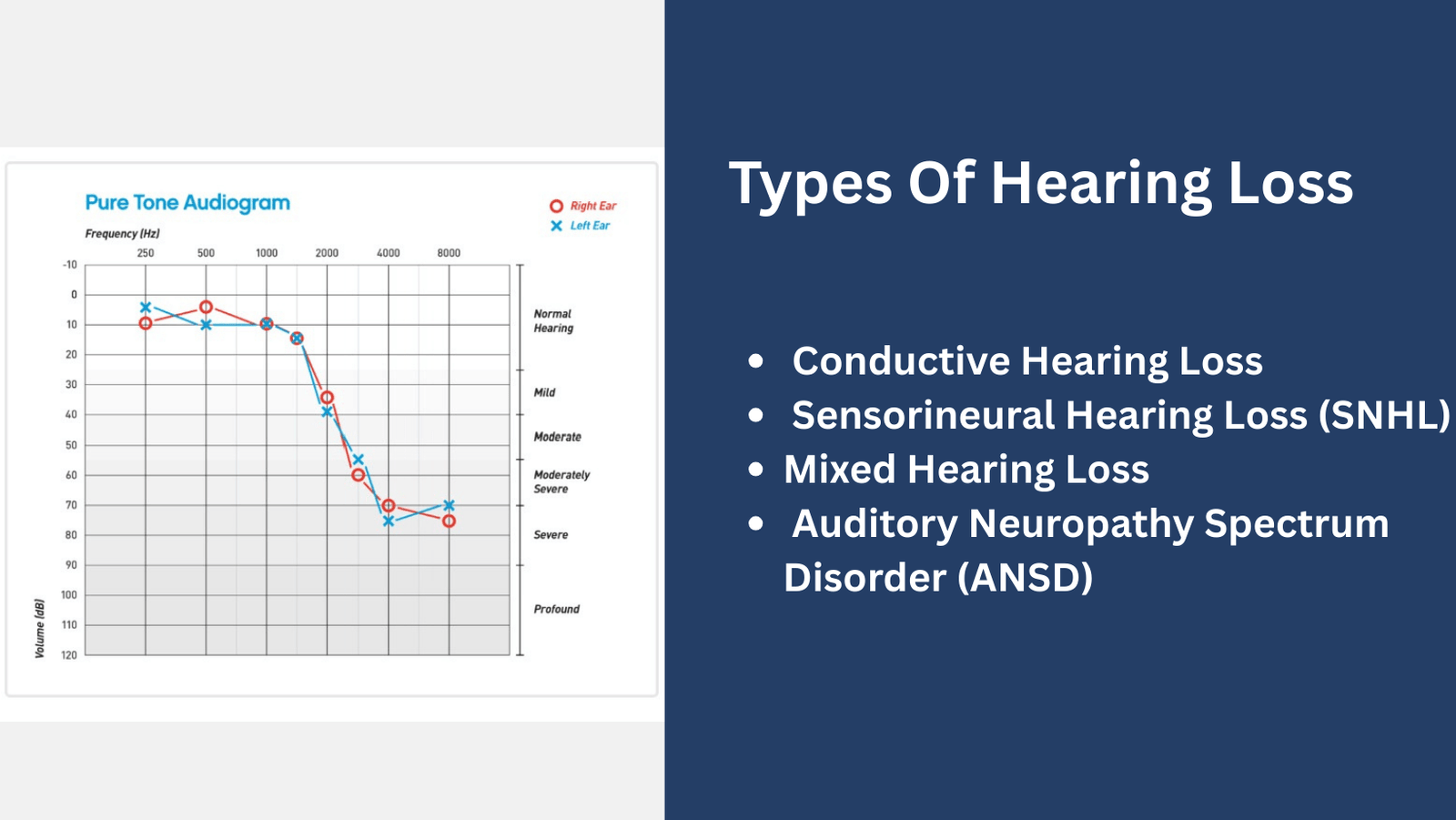 Frequencies Tested in a PTA
A standard PTA test evaluates the following frequencies:
-
250 Hz
-
500 Hz
-
1,000 Hz (1 kHz)
-
2,000 Hz (2 kHz)
-
4,000 Hz (4 kHz)
-
8,000 Hz (8 kHz)
Additional frequencies sometimes included:
-
125 Hz → low-frequency assessment
-
6,000 Hz → noise-induced hearing loss detection
-
Beyond 8,000 Hz → extended high-frequency audiometry (special cases/research)
These frequencies cover the range essential for speech understanding, especially between 500–4,000 Hz.
Understanding Pure Tone Audiometry
How Hearing Works
Sound travels in waves, each with a specific frequency (pitch). The human ear detects sounds between 20 Hz – 20,000 Hz.
The quietest sound a person can hear at each frequency is the hearing threshold.
PTA measures these thresholds to evaluate hearing sensitivity.
Two Pathways of Hearing
-
Air Conduction
Sound travels through the outer and middle ear to the cochlea. -
Bone Conduction
Vibrations stimulate the cochlea directly through the skull.
By comparing both pathways, audiologists can differentiate:
-
Sensorineural hearing loss – inner ear/auditory nerve damage
-
Conductive hearing loss – outer/middle ear issues
-
Mixed hearing loss – combination of both
Components of a PTA Test
1. Test Ear & Non-Test Ear
Only one ear is tested at a time. To prevent the better ear from assisting, masking noise is used in the opposite ear.
2. Earphones & Bone Oscillator
-
Insert earphones → air conduction
-
Mastoid bone oscillator → bone conduction
3. Audiogram
Test results are plotted on an audiogram, showing hearing thresholds at each frequency.
Understanding the Audiogram
The audiogram uses:
-
Horizontal axis: Frequencies (Hz)
-
Vertical axis: Hearing thresholds (dB HL)
Lower thresholds = better hearing.
A sample threshold table:
| Frequency (Hz) | Hearing Threshold (dB HL) |
|---|---|
| 250 | 20 |
| 500 | 25 |
| 1000 | 30 |
| 2000 | 40 |
| 4000 | 45 |
| 8000 | 50 |
Audiologists analyze the pattern to determine the type and severity of hearing loss.
How the PTA Test Is Conducted
1. Preparing the Test Environment
To ensure accuracy, PTA is performed in a sound-treated booth to eliminate ambient noise.
2. Equipment Used
-
Audiometer
-
Insert earphones
-
Bone conduction oscillator
3. Step-by-Step Procedure
-
Patient is seated in a quiet environment
-
Baseline hearing is established
-
Pure tones are presented via earphones or bone oscillator
-
Patient signals upon hearing a tone
-
The softest detectable level is recorded
-
Steps are repeated across frequencies
-
Thresholds are plotted on an audiogram
This forms the basis for diagnosing hearing loss.
Interpreting PTA Results
Audiologists interpret the audiogram to:
-
Compare thresholds to normal hearing levels
-
Identify hearing loss severity
-
Diagnose sensorineural, conductive, or mixed hearing loss
-
Evaluate speech understanding impact
Symbols on the audiogram help identify the pattern and type of hearing loss.
Common Audiogram Patterns
1. Age-Related Hearing Loss (Presbycusis)
-
Gradual decline
-
Mainly high-frequency loss
2. Noise-Induced Hearing Loss
-
A classic dip at 4,000 Hz
-
Caused by prolonged loud sound exposure
3. Conductive Hearing Loss
-
AB gap between air and bone conduction thresholds
-
Middle ear involvement (fluid, wax, perforation)
Recognizing these patterns helps audiologists determine the cause and best treatment plan.
Pure Tone Audiometry vs Sound Field Audiometry
Pure Tone Audiometry (PTA)
-
Uses headphones/insert earphones
-
Tests each ear separately
-
Provides ear-specific thresholds
-
Gold standard for diagnosing hearing loss
Sound Field Audiometry (SFA)
-
Uses loudspeakers
-
Tests both ears together
-
Used for:
-
Young children
-
Patients who cannot wear earphones
-
Hearing aid/cochlear implant users
-
Key difference:
PTA = ear-specific
SFA = overall functional hearing (better ear dominates)
Conclusion
Pure Tone Audiometry is the cornerstone of hearing assessment, providing crucial information about an individual’s hearing sensitivity. By evaluating both air and bone conduction, PTA helps identify the type, degree, and pattern of hearing loss. Accurate interpretation of the audiogram enables audiologists to offer appropriate treatment options and rehabilitation strategies.
If you’re experiencing trouble hearing or want a professional evaluation, PTA is the first and most important test to understand your hearing health.
Leave a Comment