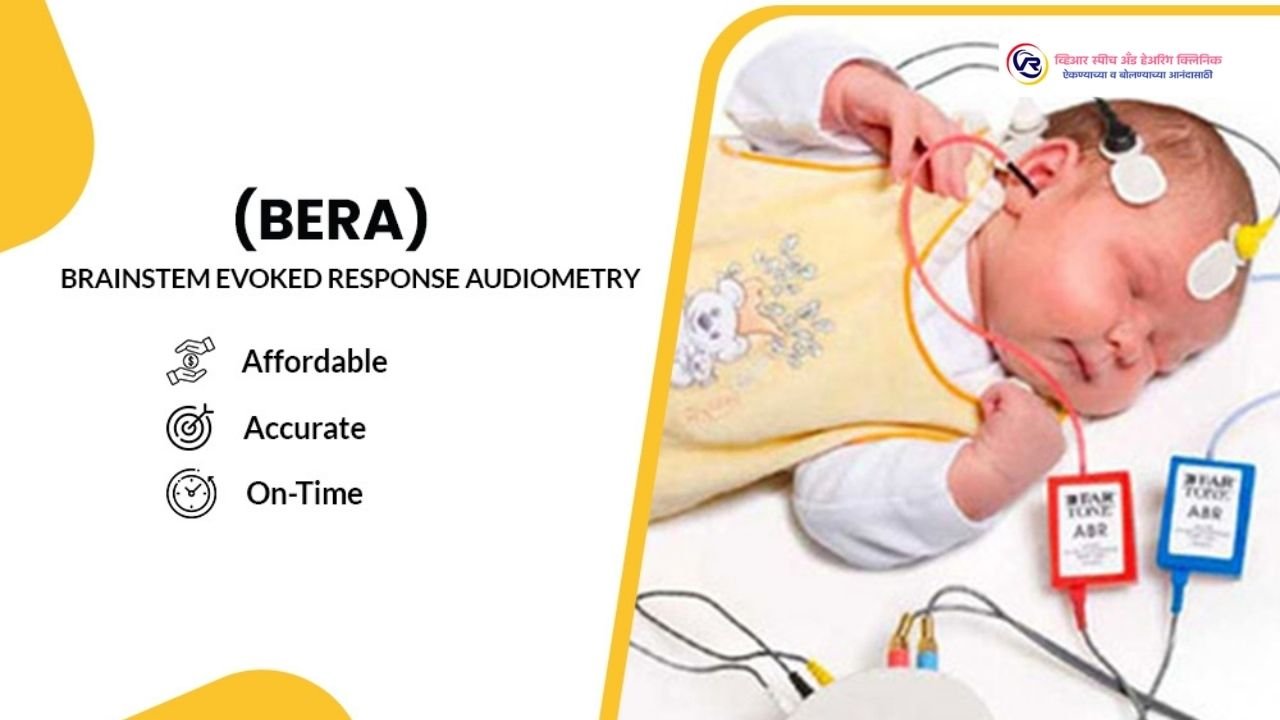
Auditory Brainstem Response (ABR) testing is a vital part of early hearing assessment, particularly for newborns and infants who cannot participate in behavioral tests. In 2025, the British Society of Audiology (BSA) introduced updated guidance to improve ABR accuracy, consistency, and efficiency. This article provides a comprehensive overview of the new ABR testing strategy, focusing on the changes made compared with the previous version and how they streamline clinical practice.
While this article summarizes the key principles, clinicians must refer to the full BSA ABR Testing in Newborns Recommended Procedure (2025) for complete guidance.
1. Preparing for ABR Testing
In the video demonstration, the Interacoustics Eclipse system was used. It is important to note that certain values—such as residual noise limits or FMP criteria—may vary depending on the device and software version being used.
Electrode Preparation
-
The Eclipse is a two-channel system, requiring four electrodes.
-
Skin preparation should be gentle yet effective to ensure good conductivity.
-
Impedances must be below 5 kΩ and evenly balanced across electrodes.
-
Ideally, no more than 1 kΩ difference between electrodes.
Once the baby is comfortably positioned and electrodes are placed, insert earphones are fitted securely before beginning the test.
2. The Two-Stage ABR Testing Strategy (BSA 2025)
A major update in the 2025 guidelines is the introduction of a structured two-stage approach:
Stage 1: Initial “First Look” Phase
The goal of this phase is not to define threshold but to quickly identify the approximate response range.
Key principles:
-
Stimulus: Example shown—4 kHz narrowband CE-Chirp.
-
Start at 10 dB above expected discharge level (commonly 35 dB nHL).
-
Continue averaging until:
-
Residual noise reaches 2× the RA requirement
-
For Eclipse (v4.4.2+): RA = 15 nV → Initial phase target = 30 nV
-
-
-
If a clear response is visible earlier, averaging can stop when the FMP criterion is met.
-
Minimum of 1000 sweeps recommended, even if FMP and morphology are strong.
The first-look phase helps clinicians rapidly narrow the testing range, saving significant time in newborn screening environments.
Stage 2: Precision Phase
After estimating threshold, clinicians switch to the precision phase to confirm results with accuracy and repeatability.
Goals:
-
Establish Clear Response (CR) vs Response Absent (RA).
-
Achieve repeatable waveforms that meet:
-
3:1 signal-to-noise ratio
-
Required FMP value
-
Correct residual noise levels
-
-
Preferably meet gold standard criteria:
-
Repeatable CR at threshold
-
Repeatable CR at level above threshold OR
-
High-quality unreplicated CR at ≥100 nV amplitude with FMP > 2.2 (for level above threshold only)
-
Waveform merging is encouraged for clarity, using the Eclipse’s Merge function instead of Add, to avoid clutter and ensure cleaner interpretation.
3. Example: Right Ear Testing Summary
-
35 dB nHL: Clear, robust waveform; FMP reached early. Averaged until morphology stabilized (~1400 sweeps).
-
25 dB nHL (≈30 dB eHL): Repeatable clear response; meets discharge criteria.
-
No need to test below discharge level once threshold is confirmed.
Result: Right ear meets discharge criteria with threshold ≤ 30 dB eHL at 4 kHz.
4. Example: Left Ear Testing Summary
-
35 dB nHL & 55 dB nHL: No clear wave V; first-look phase used; residual noise above RA requirement but acceptable for initial estimation.
-
65 dB nHL: Clear response obtained; repeatable waveforms established threshold.
-
55 dB nHL precision testing: Despite low noise after combining traces, results remained inconclusive.
-
70 dB nHL: Unreplicated strong CR used for physiological confirmation (not threshold-defining).
Result: Threshold estimated at ≤ 70 dB eHL at 4 kHz; further testing needed to resolve the inconclusive 55 dB result and to assess the nature of hearing loss (air vs bone conduction).
5. Key Improvements in the 2026 BSA ABR Guidelines
The updated guidance streamlines the process and improves diagnostic efficiency:
✔ Faster threshold estimation
The initial phase avoids unnecessary averaging at non-threshold levels.
✔ Better waveform quality control
Clear criteria for FMP, residual noise, and morphology.
✔ More consistent decision-making
Structured two-stage protocol reduces variability across clinicians.
✔ Guidance on merging traces
Encourages cleaner interpretation and reduces confusion during peer review.
✔ Practical masking recommendations
Avoids unnecessary discomfort for newborns.
6. Final Takeaways
The 2025 BSA ABR guidelines represent a significant step toward faster, more reliable newborn hearing assessment. By separating the initial rough estimation phase from the precision threshold phase, clinicians can:
-
Minimize test duration
-
Reduce infant discomfort
-
Improve accuracy in threshold determination
-
Maintain consistency across audiology departments
Clinicians should always refer to the full BSA document for complete procedural details and recommended values based on the equipment used.